# 091
by
©
Hilmar Alquiros,
Philippines
|
Hilmar Ebert
Sonderlösungsturnier
Andernach 1988 - Lösung.
Lösung, Kommentar, Verführungen, Computerlösungszeiten usw. feenschach 88 S. 384 (# Rundbrief 19. V. 1988) VII-IX 1988 |
|
|
|
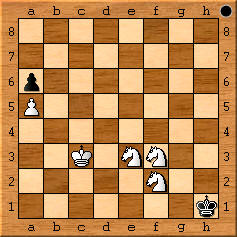
#16 in 64 Chess Compositions Hilmar Ebert feenschach IV-V 1988, Sonderlösungsturnier: Andernach, 13.-14.5.1988 Dedicated to Garry Kasparov's 50th birthday 2013 ("1.Nd5, right? - Nice!")
#6 1.Na2/a4/e2/e4? Kd1!; 1...Kb1? 2.Nd4! Ka1? 3.Kb3(4) ~ 4.Nc3+ short mates in 5. 1.Sd5!! Kd1(!) (1...Kb1? 2.Sd4! ...#5) 2.Kc3!! Ke2(!) (2...Ka1? 3.Kb3 ...#5) 3.Sd4+ Kf1 4.Ke3+ Kg1 5.Sf3+ Kh1 6.Sf2#
- Maximum distance to
the mating corner: 5 squares instead of 2 on the wrong edge! Plus ornamentation: the 3 knights form, as in the diagram, a line after 3.Nd4+ and after 5.Nf3+ rotated by 90° and 180° compared to the initial position. Only one solver, Frank Visbeen from the Netherlands (amid the gathered world elite at the Andernach Solving Tourney), managed to solve it - still without computer assistance...! The final position:
Dedication: When I played in Kasparov’s fantastic 40‑board simultaneous exhibition in Frankfurt, 2000 – against some quite strong players! – I, of course, also could not beat him, like nobody could! (at the time of his then‑record ELO rating of 2851!) – but at least I was one of the last five players still standing. :-) After my for him new second (!) move, he stood at my board for over a minute, and immediately journalists hurried over to me… After his 1.d4 Nf6 2.Bg5 Trompowsky Attack I had replied 2…c6(!), with the simple but funny “trap” 3.e3?? Qa5+ when White loses the bishop! LOL! After his long thought over his third (!) move, Garry ended all fantasies about a quick piece loss with 3.Bxf6 – but nobody knows what moved the then GOAT to think so long; presumably he had never faced this reply on the board before…
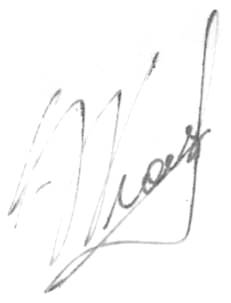
Garry’s signature after the game. Later, I found in Wikipedia an actual game with the piece loss(!): “2…c6 is an offbeat line in which Black threatens a later …Qb6, forcing White to defend or sacrifice the b‑pawn. White can play the thematic 3.Bxf6 or 3.Nf3, but must avoid 3.e3?? Qa5+, when White resigned (in light of 4…Qxg5) in Djordjević – (Milorad) Kovačević, Bela Crkva 1984—‘the shortest ever loss by a master’ (Graham Burgess, The Quickest Chess Victories of All Time, p. 33)."
16* Hilmar Ebert feenschach I-IX 1991
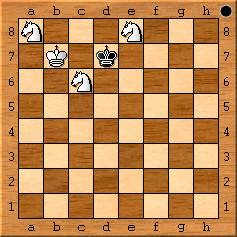
#9
1.Nac7? stalemate! Unexpectedly back into the 'left corner of the gate' – a tough nut to crack!
16** Hilmar Ebert (& Bernhard Walter)
Rochade Europa III/1995
S. 44-45
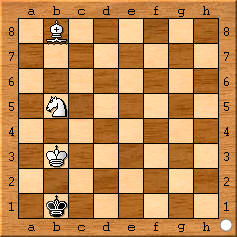
#13 1.Kc3! Kc1 2.Bg3 Kd1 3.Kd3 Kc1 4.Be5 Kd1 5.Bc3 Kc1 6.Na3 Kd1 7.Nc4 Kc1 8.Bd2+ Kb1 9.Kc3 Ka1 10.Kb3 Kb1 11.Kc2 Ka1 12.Na3+ Ka1 13.Bc3# Garry's favorite number (birthday April 13; World champion #13, Garry Kasparov = 13 letters and more!). For the first time, all white moves are dual-free - in all variations! |
# 090: Sonderlösungsturnier Andernach 1988. (13. + 14. Mai).
Matt in 6 Zügen, Miniatur mit 3 Springern gegen König.
feenschach (87) S. 289
IV-VI 1988
# 091: Sonderlösungsturnier Andernach 1988 - Lösung.
Lösung, Kommentar, Verführungen, Computerlösungszeiten usw.
in : feenschach 88 S. 384, (& Rundbrief 19. V. 1988)
VII-IX 1988
 ©
by
Hilmar Alquiros,
The Philippines
Impressum Data
Protection Statement / Datenschutzerklärung
©
by
Hilmar Alquiros,
The Philippines
Impressum Data
Protection Statement / Datenschutzerklärung
û
“” „“ «»