
# 236:
©
Hilmar Alquiros,
Philippines
Haben Sie Schachhumor? – Do you have chess humor?
Ein Selbsttest in 7 Schritten. – A self test in 7 steps.
|
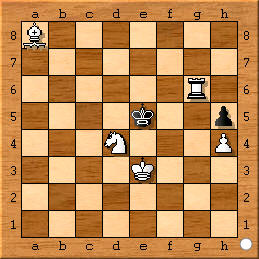
Was Humor ist, darüber scheiden sich bekanntlich die Geister. Humorvoll kann man jedenfalls die Tatsache finden, dass sich offenbar niemand für humorlos hält ... Humor ist, wenn man trotzdem mattsetzt! Vor allem im Problemschach, wo es immer erst mal nicht geht – so wie man möchte! Als Testbeispiele dienen ausschließlich Kompositionen meines langjährigen Schachfreundes Hilmar Ebert (he) aus Aachen: Er hatte gemeinsam mit Herbert Bastian im gleichen Schulschachklub in Völklingen die ersten ernsthaften Gehversuche im Schach begonnen! Und nun geht es los: einfach die Punkte derjenigen (witzigerweise selbst gelösten) Aufgaben addieren, deren Abspiele Sie für humorvoll halten! Nr. 1: Ist 1.Kc7 wirklich ein Matt?! (1 Punkt) Nr. 2: Aha - nicht nur König und Turm, nein alle weißen Steine stehen auf den Ausgangsfeldern! Ein schwaches Kerlchen auf g4 bietet da nicht viel Schutz. Der Weiße hat sich brav das Rochaderecht bewahrt - wie viele Minuten bis zur Lösung? (2 Punkte) Nr. 3: Ein gesunder Geist in einem gesunden Körper? Wohlan, etwas Preiskegeln sorgt für die rechte Bewegung - und die vier „Home-Base“-Steine von eben dürfen nun keine ruhige Kugel schieben ... (3 Punkte) Nr. 4: Eine atemberaubende Bereicherung der Endspieltheorie: Wie gewinnt man mit gleichfarbigen Läufern (einer muss durch Umwandlung entstanden sein!) gegen schwarze Bauern? (4 Punkte) Nr. 5: Weniger bekannt ist, dass das moderne ökologische Bewusstsein bis in die Problemkomposition eingedrungen ist. Wer Vieles bringt, wird manchem etwas bringen ... (Faust). Vier Schachaufgaben im Schuber, ökologisch anständig - drei Verpackungen eingespart. Mit vor Sinntiefe triefender Widmung. Wie verhalten sich Ihre vier Lösungszeiten zueinander? (4 Punkte) Nr. 6: Die Schluss-Stellung einer sehr freien Partie des Verfassers nach schwer durchzechter Nacht. Schwarz hatte frechweg ausschließlich Springerzüge demonstriert - und dabei etwas von „Super-Aljechin“ in den Bart gemurmelt. Ohne mit der Wimper zu zucken, reduzierte er empfindlich das weiße Lager, hielt aber die eigenen Mannen umsichtig gedeckt. Weiß wiederum hatte mit wahrlich undurchschaubaren (!) problemschachlichen Manövern drei seiner Bauern zu Damen geführt, was ihm im nüchternen Zustand nicht im Traum eingefallen wäre. Eine hundsgemeine Materialverteilung war das - wer stand hier eigentlich besser? Das Blättchen bog sich bereits bedrohlich gen Himmel, als dem Weißen plötzlich dämmerte, welche Kräfte doch einem Harem innewohnen ... (6 Punkte) Nr. 7: Etwas für starke Nerven: unter der geballten Löser-Weltelite in Andernach 1988 fand nur ein Experte (innerhalb von 24 Stunden - ohne Computer!) den versteckten Weg. (10 Punkte) |
What is humor is a subject of contention. What is humorous, however, is the fact that no one seems to think they are humorless. Humour is when you still checkmate! Especially in problem chess, where it's always not possible at first – as you like it! Only compositions of my longtime chess friend Hilmar Ebert (he) from Aachen serve as test examples: Together with Herbert Bastian in the same school chess club in Völklingen he had started his first serious attempts in chess! And now it starts: just add up the points of those (funnily enough self-solved) tasks whose play you think is humorous! No. 1: Is 1.Kc7 really a Matt?! (1 point) No. 2: Aha - not only king and rook, no all white pieces are on the starting squares! A weak guy on g4 does not offer much protection. The white man has retained his castling rights - how many minutes until the solution? (2 points) No. 3: A healthy mind in a healthy body? Come on, a little price skittles ensures the right movement - and the four "home-base" stones from just now are not allowed to push a calm ball ... (3 points) No. 4: A breathtaking addition to the endgame theory: How do you win against black pawns with bishops of the same colour (one must have been created by promotion!)? (4 points) No. 5: What is less well known is that modern ecological awareness has penetrated right down to the composition of the problem. Those who bring a lot will bring a lot to some... (Faust). Four chess problems in a slipcase, ecologically decent - three packages saved. With a dedication dripping with depth of meaning. How do your four solution times relate to each other? (4 points) No. 6: The final position of a very free game of the author after a night of heavy drinking. Schwarz had cheekily demonstrated only jumping moves - and muttered something of " super Alekhine" into his beard. Without batting an eyelid, he sensitively reduced the white camp, but carefully covered his own men. White, on the other hand, had led three of his peasants to queens with truly inscrutable (!) problem-chess maneuvers, which he would never have dreamed of in his sober state. It was a doggone distribution of material - who was actually in a better position? The leaf was already bending menacingly towards the sky, when suddenly it dawned on the white man what powers are inherent in a harem ... (6 points) No. 7: Something for strong nerves: among the concentrated solver world elite in Andernach 1988 only one expert (within 24 hours - without computer!) found the hidden way. (10 points) |
Nr. 1 - Hilmar Alquiros
diagrammes 1979
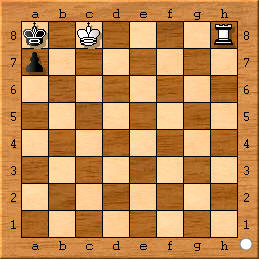
Matt in wie vielen Zügen?
Nr. 2 - Hilmar Alquiros
Lüneburger Landeszeitung 1988
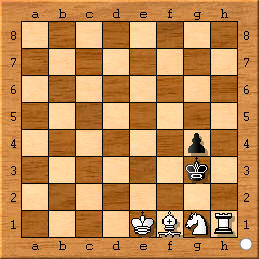
Matt in 5 Zügen
Nr. 3 - Hilmar Alquiros
Stern 1989
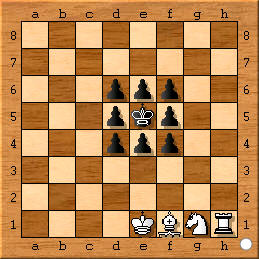
Matt in 5 Zügen
Nr. 4 - Hilmar Alquiros
Schweizerische Schachzeitung 1978
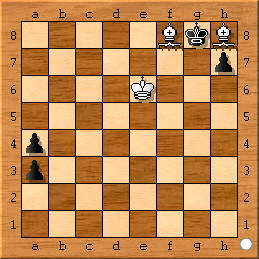
Weiß gewinnt?!
Nr. 5 - Hilmar Alquiros
feenschach 1992
H. Gruber zum 1. bis 4. Advent gewidmet
Matt in genau 1, 2, 3 und 4 Zügen!
Nr. 6 - Hilmar Alquiros
Weihnachts- und Neujahrsgruß 1994/95
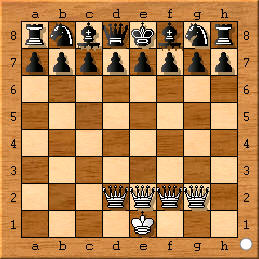
Weiß gewann, aber wie am schnellsten und elegantesten?
Nr. 7 - Hilmar Alquiros
feenschach 1988
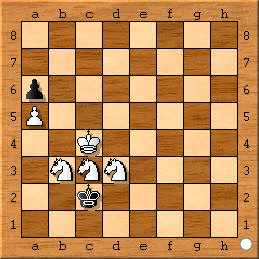
Weiß kündigt ein Matt in 6 Zügen an ...
|
Uff! Gesamtpunktzahl (ohne Computer!) notiert ?! Humorigerweise zuerst das Testergebnis:
1 bis 3 Punkte: Schachhumor ist nichts für Sie, bleiben sie seriös bis zum Zähneknirschen: lösen Sie ausschließlich orthodoxe Zweizüger, das ist Strafe genug. 4 bis 10 Punkte: Genetisch nicht unbedingt hoffnungslos, aber Ihr Humorzentrum im linken Vorderlappen braucht Nahrung. 11-20 Punkte: Der Anfang ist getan: Großmeisterliche Hirnwindungen direkt vor dem Lustzentrum ... 21-29 Punkte: Genialer Schachhumor! 30 Punkte: Von welchem Planeten kommst Du? |
Whew! Total score (without computer!) noted ?! Humorously, the test result first:
1 to 3 points: Chess humor is not for you, stay serious to the point of gnashing your teeth: solve only orthodox twomovers, that's punishment enough. 4 to 10 points: Genetically not necessarily hopeless, but your left frontal lobe humor center needs nourishment. 11-20 points: The beginning is done: Grandmasterly gyri of the brain right before the pleasure center... 21-29 points: Great chess humor! 30 points: What planet are you from? |
* H. Ebert
 ©
by
Dr. Hilmar Alquiros,
The Philippines
Impressum Data Protection Statement / Datenschutzerklärung
©
by
Dr. Hilmar Alquiros,
The Philippines
Impressum Data Protection Statement / Datenschutzerklärung
û
# 236b:
©
Hilmar Alquiros,
Philippines
Haben Sie Schachhumor? – Do you have chess humor?
Ein Selbsttest in 7 Schritten. – A self test in 7 steps.
Lösungen - Solutions
|
Haben Sie Schachhumor? |
Do you have chess humor? |
|
Für die Nichtlöser und für die Humorlosen hier noch die Lösungen |
For the non-solvers and for the humourless here are the solutions: |
|
#6 Nr. 1: Hilmar Alquiros 1.Kc7 matt?! - Schwarz hat in der Diagrammstellung keinen letzten Zug, somit kann nicht Weiß am Zuge sein! Und Schwarz wehrt sich zunächst mittels:
0...a5
(!) und nun geht's los: 1.Kc7+!
Ka7
2.Kc6!!
a4 3.Th4!
a3 4.Ta4+
Kb8
5.Ta3:
Kc8
6.Ta8
matt. |
#6 Nr. 1: Hilmar Alquiros Black has no last move in the diagram position, so white can't have a move! And black fights back at first by means of:
0...a5
(!) und nun geht's los: 1.Kc7+!
Ka7
2.Kc6!!
a4 3.Th4!
a3 4.Ta4+
Kb8
5.Ta3:
Kc8
6.Ta8
matt. |
|
Retroanalyse im Wenigsteiner (Aufgaben und Endspiele bis 4 Steine): für diese „Euklidischen Elemente“ des Problem- und Studienschachs hatte ha=he in jungen Jahren die weltweit umfassendste Sammlung aufgebaut („SAM“, > 25.000 Probleme!) Nr. 2: Hilmar Alquiros
#5
1.Th5!
Kf4
2.Se2+
Kf3
3.Kd2!
g3 (3...Ke4?
4.Lg2
matt) 4.Th4
~ 5.Tf4#;
Insgesamt 9 Varianten, die weißen Züge sind stets eindeutig! |
Retro-analysis in the Wenigsteiner ( problems and endgames up to 4 pieces): for these "Euclidean elements" of problem and study chess ha=he had built up the most comprehensive collection worldwide in his young years ("SAM", > 25,000 problems!). Nr. 2: Hilmar Alquiros
#5
0...a5
(!) und nun geht's los: 1.Kc7+!
Ka7
2.Kc6!!
a4 3.Th4!
a3 4.Ta4+
Kb8
5.Ta3:
Kc8
6.Ta8
matt.
Altogether 9 variations, the white moves
are always explicit! |
|
Nr. 3: Hilmar Alquiros
Nicht 1.K3? ed3:?! 2.Sf3+! Ke4 3.Sd2+! Ke5(!) 4.Th4 f3 5.Sf3: matt wegen 1...f3! Daher: 1.Sf3+! ef3: 2.Ld3 f2+ 3.Kf2: f3 4.Kf3: f4 5.Te1 matt. Opfer in Verführung und Lösung (he-chess[1] Nr. 3 = Kegelschach, 1998). |
Nr. 3: Hilmar Alquiros
Nicht 1.K3? ed3:?! 2.Sf3+! Ke4 3.Sd2+! Ke5(!) 4.Th4 f3 5.Sf3: matt wegen 1...f3! Daher: 1.Sf3+! ef3: 2.Ld3 f2+ 3.Kf2: f3 4.Kf3: f4 5.Te1 matt. Sacrifice in try-play and solution! (he-chess[1] Nr. 3 = Kegelschach, 1998). |
|
Nr. 4: Hilmar Alquiros
White wins(!)
1.Lh6!
a2 (!) 2.La1!!
a3 3.Kf6
Kh8
4.Kf7
matt. Theorie-Ausnahme: hier gewinnen zwei gleichfeldrige weiße Läufer - nach doppelter Schnittpunktüberschreitung des Feldes g7 - gegen mehrere schwarze Bauern: mit dem so genannten Inder: vorübergehende Selbstverstellung zwecks Pattvermeidung und Abzug. Von wegen höchstens Remis – mehr Kampfgeist |
Nr. 4: Hilmar Alquiros
White wins(!) 1. Bh6! a2 (!) 2. Ba1!! a3 3. Kf6 Kh8 4. Kf7 mate (If 1... Kh8?! then 2. Kf7! followed by 3. Bg7#) Theoretical exception: here, two white bishops of the same square color win - after crossing the square g7 twice - against several black pawns: with the so-called Indian: temporary self-blocking to avoid a stalemate and deduction. A "draw" - more fighting spirit!
Theoretical exception: Here, two white bishops on same-colored squares succeed in checkmating alone – even against several black pawns! This is possible due to double intersection clearance of square g7. An unexpected Indian theme: A momentary self-block is used deliberately to avoid stalemate and enable a powerful discovered mate.
1.Lh6!
a2 (!) 2.La1!!
a3 3.Kf6
Kh8
4.Kf7
matt.
|
|
Nr. 5: Hilmar Alquiros
1) 1.Te6
matt; Pattaufhebung, Mattwechsel, Selbstverstellung und Tempospiel. Und nicht 1.Tc6? Kd5 2.Lb7 Ke5 3.Sf3+? (3...Kf5? 4.Lc8 matt) wegen 3...Kd5! 4.?? Eigentlich erbaulich eine Lösung pro Dezemberwoche vorgesehen ... |
Nr. 5: Hilmar Alquiros
1) 1.Te6
matt; Stalemate removal, mate change, self-blocking and tempo play. Actually in an elevating way one solution per week in December is supposed...
Hilmar Ebert feenschach 1992 Dedicated to H. Gruber for the 1st to 4th Advent
Mate in exactly 1,2,3 and 4 moves! 1) 1.Re6# 2) 1.Nf3+! Kf5 2.Be4# 3) 1.Rc6! Kd5 2.Bb7! Ke5 3.Re6# 4) 1.Ne2! Kf5 2.Nf4 Ke5 3.Nd3+ Kf5 4.Be4#. Not 1.Rc6? Kd5 2.Bb7 Ke5 3.Nf3+? (3…Kf5? 4.Bc8#) because 3…Kd5! 4.?? A quadruple-set problem with four exact mates in 1, 2, 3 and 4 moves - the solutions form two pairs, a/c and b/d, connected by subtle changes of play. There are self‑blocks, tempo maneuvers and changed mate, with a touch of gentle seduction. Ideally, one solves them week by week, like lighting the four Advent candles! By a small Christmas miracle, the position stubbornly refuses to yield a mate in five… :-)
|
|
Nr. 6: Hilmar Alquiros
White wins!
Wenn Schwarz sich ernsthaft wehrt, führt jeweils nur ein eindeutiger, dualfreier Zug von Weiß zum Erfolg 1.Df7:+! Kf7: 2.Dd-f4+ Sf6 3.Df6:+! Kg8(!) 4.Dh5! g6(!) 5.Dg2-g6:+! hg6: 6.Dh8: matt. Drei mal Damenopfer! Das zweite nahm Schwarz lieber nicht an wegen 3...Kf6:? 4.De2(g2) f3+ ... usw.; natürlich ohne Anspruch auf Legalität (Partie-Erspielbarkeit)! Solche „SPAsS“-Stellungen (Schwarzen Partie-Anfangs-Stellungen!) wurden von he systematisch studiert (feenschach 1976; Die Schwalbe 1995). Dieser „Weihnachts- und Neujahrsgruß“ erfuhr in Computerschach & Spiele (1995 S. 44) in der Lösungsbesprechung einen humorvollen Abgang, als ein Herr Quack fragte: „Wo sollen die Umwandlungsdamen entstanden sein?“ und flugs empfahl, die Stellung um 1800 zu drehen, jetzt mit profaner Lösung 1.Dc2: Kc2: 2.De4+ nebst Matt im 3. Zug. |
Nr. 6: Hilmar Alquiros
White wins!
If Black seriously resists, only one clear, dual-free move by White will lead to success: 1.Df7:+! Kf7: 2.Dd-f4+ Sf6 3.Df6:+! Kg8(!) 4.Dh5! g6(!) 5.Dg2-g6:+! hg6: 6.Dh8: matt. Three times Queen sacrifice! The second one black did not accept because of 3...Kf6:? 4.De2(g2) f3+... etc.; of course without any claim to legality (endgame playability)! Such "SPAsS" positions (black game starting positions!) were systematically studied by he (feenschach 1976; Die Schwalbe 1995). This "Christmas and New Year's greeting" experienced a humorous end in the solution's discussion in Computerschach & Spiele (1995 p. 44), when a Mr. Quack asked: "Where should the promoted Queens have been created?" and quickly recommended to turn the position around by 180°, now with the profane solution 1.Dc2: Kc2: 2.De4+ together with mate in the 3rd move. |
|
Nr. 7: Hilmar Alquiros
#6
1.Sd5!! Kd1(!) 2.Kc3!! Ke2 3.Sd4+ Kf1 4.Se3+ Kg1 5.Sf3+ Kh1 6.Sf2 matt. 1...Kb1? 2.Nd4!... oder 2...Ka1? 3.Kb3(4) ~ 4.Nc3+ ... führen zu Kurzmatts im 5. Zug.
Maximale Entfernung der Mattecke: 5 Felder
statt 2 am falschen Rand a1 ... Plus ein bisschen Ornamentik: die drei Springer bilden, wie in der Diagrammstellung, nach 3.Sd4+ und nach 5.Sf3+ jeweils eine Linie (90° und 180° gedreht). |
Nr. 7: Hilmar Alquiros
#6
1.Sd5!! Kd1(!) 2.Kc3!! Ke2 3.Sd4+ Kf1 4.Se3+ Kg1 5.Sf3+ Kh1 6.Sf2 matt. 1...Kb1? 2.Nd4!... oder 2...Ka1? 3.Kb3(4) ~ 4.Nc3+ .. lead to short mates in the 5th move. Maximum distance of the mate corner: 5 fields instead of 2 at the wrong edge a1 ... and without the white king, only by the three white knights! Plus a little ornamentation: the three knights form a line (rotated 90° and 180°) after 3.Sd4+ and after 5.Sf3+, as in the diagram position. |
|
Sie haben das wirklich alleine gelöst?! Bitte outen Sie sich und melden Sie sich bei der Schachhumormeisterschaft der Intergalaktischen Föderation an! |
You really solved this on your own?! Please come out and register for the Chess Humor Championship of the Intergalactic Federation! [1] |
©
by
Dr. Hilmar Alquiros,
The Philippines
Impressum Data Protection Statement / Datenschutzerklärung
û


